

Why do some rental properties lease within days while others sit on the market for months?
After 17+ years in the business and more than 600 investment properties delivered, we have learned that rentability is not random.
I also asked Angela Valdez of Lantana Property Management for input. Angela and her team manage more than 250 properties for our clients, so she sees these patterns every day.
It comes down to how renters search.
Most renters follow a two-step process:
- Elimination, they remove properties that do not meet their basic requirements.
- Selection, they compare the remaining properties and choose the one that fits them best.
This is why understanding your target tenant segment matters before you buy.
Step 1: Elimination
Before a renter ever visits a property, they filter out anything that does not meet their basic housing requirements.
For example, a household earning $80,000 per year may qualify for a maximum rent of roughly $2,000 per month.
$80,000 ÷ 12 × 30% = $2,000
That means they will likely eliminate anything priced above that amount. They may also question a property priced far below the expected range, because it can signal that something is wrong.
The same process applies to property type, bedroom count, bathroom count, garage size, location, and layout.
If your property fails one of the tenant segment’s basic requirements, that tenant will likely never see it in person.
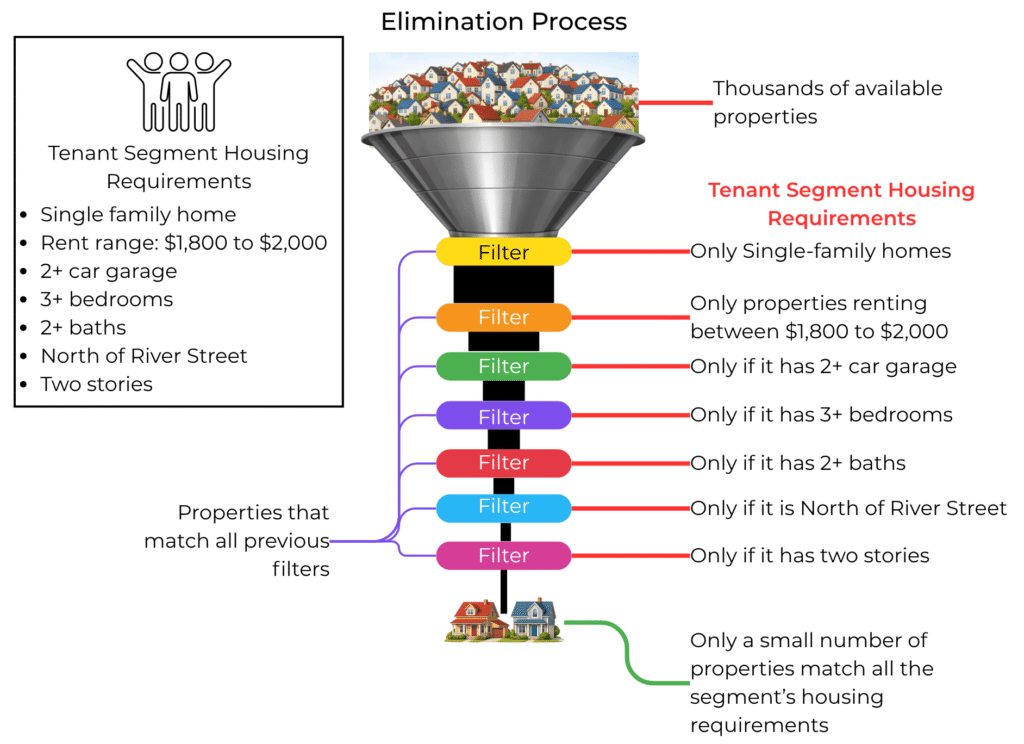
This is what the diagram below shows. Thousands of available properties enter the funnel. Each filter removes more properties. Only a small number match all the tenant segment’s housing requirements.
What Gets a Rental Property Eliminated?
Here are some of the most common reasons single-family rental homes in Las Vegas struggle to rent.
Above-market rent
Starting with above-market rent is one of the most costly mistakes an owner can make.
The logic sounds reasonable: price high, then negotiate down.
But rentals usually do not work that way.
Tenants compare your property to other available homes. If similar homes are priced correctly, your property looks overpriced. It gets skipped.
Then the property sits. Price cuts follow. By then, the long time on market can make renters wonder what is wrong with the home. In many cases, the owner ends up renting below market just to get activity.
Angela made the same point:
“This is one of the biggest mistakes landlords make. They often compare the rental market to the sales market, or even to selling a car, thinking they should price higher to leave room for negotiation. In reality, rent is rarely negotiated. Tenants pay the listed price.”
Poor marketing photos
This one surprises owners more than it should.
I regularly see rental listings for homes I know are attractive and well-lit, but the photos make the property look dark, small, and uninviting.
Photos are usually the first showing.
If the photos are poor, many tenants will never schedule an in-person visit.
Good photography is one of the cheapest, highest-return marketing investments a rental owner can make. This is not the place for “Uncle Bob” with a phone camera.
Layouts the tenant segment does not want
Some layouts are hard to rent because they do not fit how the target tenant lives.
For our tenant segment, tri-level or three-story homes are usually a problem. Single-story and two-story homes are the expectation. Anything outside that pattern has a much harder path to occupancy.
Angela also pointed out several layout issues that can cause tenants to pass on a property:
- Stairs placed awkwardly
- Garage access that opens into the middle of the living room
- Living areas too small to comfortably fit furniture
These issues may not show up clearly in a spreadsheet, but tenants notice them immediately.
Location within the community
A property can be in the right neighborhood and still have a location problem.
Angela gave a good example:
“The specific location within a community makes a big difference. A property can check all the boxes and be in a great neighborhood, but if it’s on a corner at the entrance or backs up to a major road, that’s a turnoff for many tenants.”
This is one reason we evaluate the property, the street, the surroundings, and the tenant experience before recommending a purchase.
All-electric appliances
Most renters in our target segment strongly prefer gas stoves, gas dryers, and gas water heaters.
All-electric homes usually take longer to rent and often bring in lower rents. They also tend to have lower renewal rates.
Angela explained why:
“Properties with all-electric appliances tend to have lower renewal rates. These homes typically come with significantly higher power bills, and tenants burdened by those costs are less likely to stay.”
This is a good example of a feature that may seem minor to an investor but matters to the tenant.
Decorating to the owner’s taste
You will not live in the rental property.
Your preferences do not matter.
The tenant segment’s preferences matter.
Years ago, a painting company owner from San Francisco bought an investment property and painted the interior emerald green, with light green ceilings. He believed the bold design justified above-market rent.
The property received almost no interest.
After two months, he asked us to call prospective tenants and explain that green was the new popular color.
The property finally rented shortly after the walls were repainted a neutral light tan and the ceilings were painted white.
Angela has seen similar problems:
“We’ve had situations where landlords take on renovations themselves as a fun project and design everything to their personal taste. Unfortunately, these rarely turn out well. The finishes are often too specific and don’t appeal to the broader market, and the quality typically doesn’t match what a professional would deliver.”
A rental property should not be designed for the owner. It should be prepared for the tenant segment most likely to rent it.
Step 2: Selection
After renters eliminate properties that do not meet their basic requirements, they build a short list.
Then they rank the remaining homes.
This is where preferences matter.
For our target tenant segment, stainless steel appliances and hard-surface countertops often move a property higher on the list. Clean flooring, fresh paint, good lighting, and a well-kept yard also matter.
The highest-ranked properties get viewed first.
And first impressions begin at the curb.
Curb appeal matters
I once worked with a client who renovated the interior of a property but left the front yard untouched.
The yard had dirt, rock, broken glass, and weeds.
Comparable homes in the area rented in about two weeks. This property sat for nearly three months and finally rented only after a price reduction.
The painful part was that a landscaper had quoted about $350 to make the yard acceptable.
The owner declined.
Trying to save $350 cost the owner roughly $6,000 in lost rent, plus the ongoing loss from renting below market.
We chose not to work with that client again.
The property must be market-ready
A dirty, smelly, damaged, or unfinished property sends a strong message to prospective tenants.
And it is not a good one.
Early in my career, I saw a rental home with a large hole in the sheetrock near the front door. Someone had placed a handwritten Post-it note next to it saying the repair would be completed before move-in.
The note even had misspellings.
The property sat for months.
Angela still sees this today:
“We still see this with investors who try to rent a property as-is with minimal preparation, no fresh paint, limited cleaning, and repairs left unfinished. In those cases, the property usually attracts lower-quality applicants, and those tenants often return it in even worse condition. If someone is comfortable living in a home like that, they usually will not take good care of it. Doing the work upfront and making the property presentable helps attract better tenants who are more likely to maintain the home.”
This is an important point.
A well-prepared property does not just rent faster. It usually attracts a better tenant.
Neighbors matter
Sometimes the issue is not the property itself.
It is what surrounds it.
Angela shared this example:
“We once showed a property where the house next door had people outside drinking, working on cars, and playing loud music. The prospects didn’t move forward after that.”
This is why we do not evaluate a property only by price, rent, and photos. We also care about the street, nearby homes, and the experience a tenant will have when they arrive.
Some Properties Do Not Fit Any Strong Tenant Segment
Some properties are hard to rent because they do not clearly fit any reliable tenant segment.
Examples include homes that back up to high-voltage power lines, homes with odd bedroom-to-bathroom combinations, or properties with layouts that do not match how most families live.
When a property does not fit a clear tenant segment, the only tool left is price.
You have to discount the rent enough to make the property too cheap to ignore.
That creates two problems.
First, the rent is lower.
Second, the tenant is often less likely to stay long term, because they chose the property mainly because it was cheap.
That is not the foundation for reliable long-term rental income.
The Main Point
Renters do not search randomly.
They eliminate first. Then they select.
If a property fails the basic requirements of the target tenant segment, it may never get considered.
If it passes the basic requirements but fails on presentation, layout, curb appeal, photos, or pricing, it may sit on the market while better-prepared properties rent first.
This is why we start with the tenant segment before we buy the property.
No property has ever paid rent.
The tenant pays the rent.
And the easier you make it for the right tenant to choose your property, the easier the property is to rent.