
Most rental property analysis starts with the wrong question: “Is this a good deal?”
A better question is: “Will this property attract the tenant segment I want?”
At Fernwood, we evaluate rental properties through a tenant-centric process. The property must attract tenants who stay for years, pay on schedule, take care of the home, and have stable income even during recessions. That is what makes rental income more predictable.

Most investors start by looking for a low cost property. The result is unpredictable performance. The better approach is: which properties should I buy to attract the right tenant segment? The reality is that the tenant is the key. No property ever paid rent; tenants pay the rent. The property is simply a container the tenant pays to occupy. Your financial success depends more on tenant performance than on the property itself.
So, we first ask whether a property will attract a tenant segment with a high concentration of reliable tenants. What makes a tenant reliable?
- They stay many years.
- They pay rent on schedule.
- They take care of the property.
- They have jobs likely to continue even during recessions.
That is the tenant segment we want occupying our properties. The goal is financial, not selecting a property based on your feelings or other people’s opinions.
Build a Property Profile
“If you don’t know where you are going, you might end up someplace else.” …Yogi Berra
Before you start looking for a property, you need to know what you are looking for.
The Fernwood approach is simple: find out what and where the reliable tenant segment currently rents, and buy similar properties.
The best way to determine where the reliable tenant segment currently rents is to talk to experienced property managers. When I started, I asked about 15 property managers the following question:
- “If you wanted to buy properties that attract tenants who stay for many years and pay rent on schedule, what would you buy?”
Thirteen of the 15 property managers specified the same properties. I also asked follow-up questions about major repair risks, property features to avoid, and location issues that could make the property harder to rent.
From those conversations, I built what I call a property profile. A property profile is a physical description of the homes most likely to attract the tenant segment you want. Below is an example.
The exact profile will vary by city and tenant segment, but the structure looks like this:
- Property type: single-family homes
- Property price range: You can determine the appropriate property price range by evaluating the properties they currently rent. For example, our tenant segment can only afford to rent properties that cost between $350,000 and $475,000 in today’s market. Properties priced higher or lower would not attract our target tenant segment.
- Configuration: one or two stories, 2+ car garage, 3+ bedrooms, 2+ baths, 1,200 to 1,800 square feet, fenced backyard
- Location: north of River Street, east of MLK Drive, west of 5th Street, and south of Raceway Blvd.
- Year built: 1985 or newer
- Major repair risks to avoid: flat roofs, wood-shingle roofs
- Avoid: close proximity to busy roads or high-voltage power lines
With a clear property profile, you can stop guessing. If a property fails to match any of the characteristics above, remove it from consideration.
Vet Properties Against Your Property Profile
Below are the steps we use to decide whether a property will attract our target tenant segment. We start with the property type and remove any property that does not match all the additional filters. See the image below for the process.
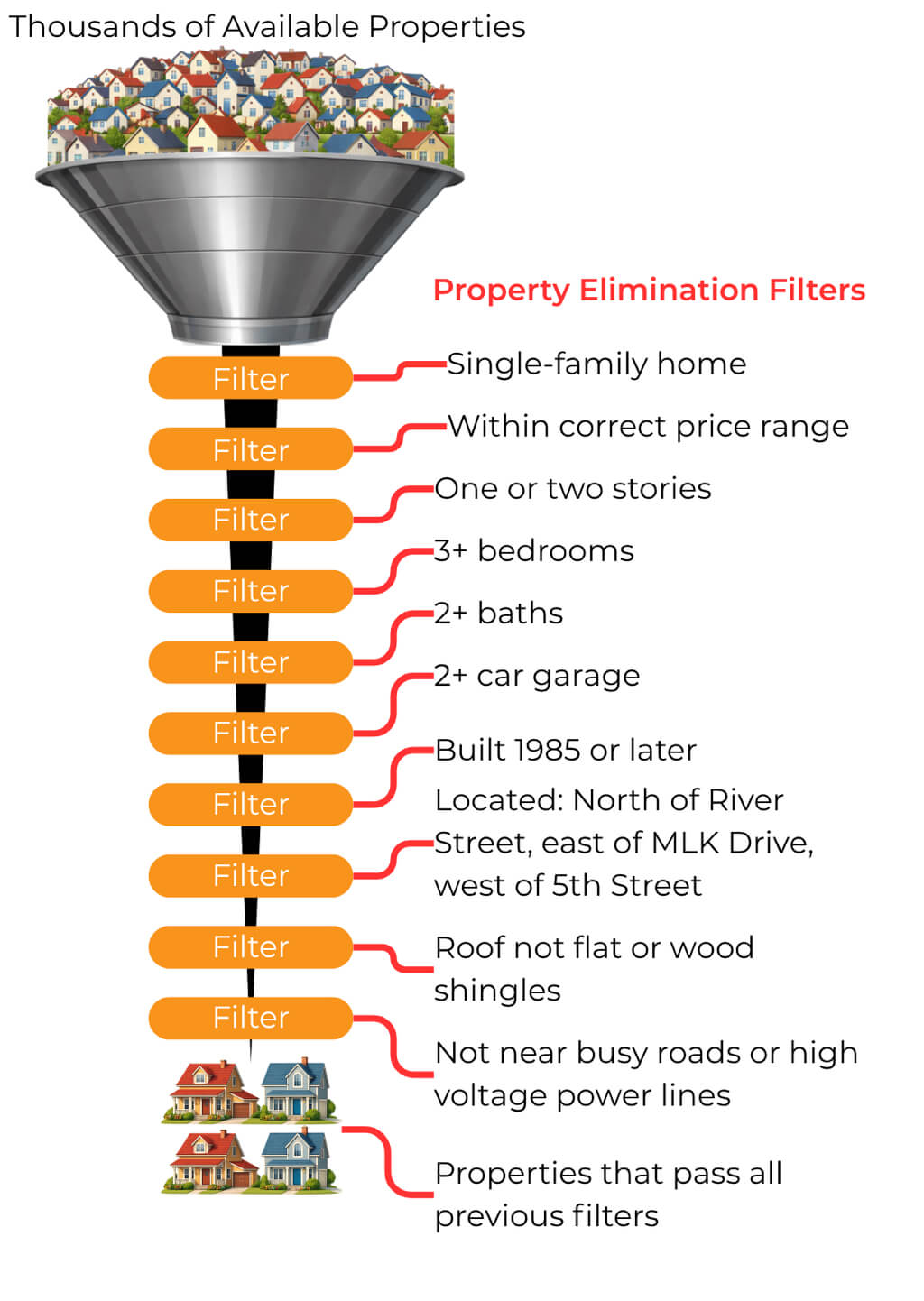
Just meeting these requirements does not necessarily mean the property will attract our target tenant segment. Before we recommend any property to our clients, we ask the property manager for input. About one in 10 properties is eliminated by the property manager for subjective reasons, based on their years of experience. The property manager evaluates:
- Will this property attract our target tenants?
- What is the likely rent range?
- How long should it take to rent?
- Does the layout, location, or condition create any concerns?
The property manager helps us avoid mistakes before a client buys.
Additional Considerations
A property must also meet minimum financial requirements, including acceptable renovation cost and risk.
- Is the initial ROI and cash flow acceptable? Even after a property passes our tenant-segment filters, most still fail the financial test. In our process, about 95% of properties that survive the initial filters are eliminated because the expected cash flow or ROI does not meet our requirements.
- Are the renovation costs and risks acceptable? Every property will need some renovation to be market-ready. Some will need significantly more than others. Depending on the condition, the renovation cost may be high enough that the property no longer makes sense.
Conclusion
A property is not a good rental just because it looks nice, sits in a desirable area, or seems attractively priced. It is a good rental only if:
- It attracts your target tenant segment.
- It works financially
- The renovation cost and risk are acceptable
Want help evaluating whether a Las Vegas rental property fits the right tenant segment?
We help investors identify, evaluate, acquire, renovate, and manage rental properties built around reliable long-term tenants.
If you are considering investing in Las Vegas, schedule a discovery call and we can help you think through whether our process is a fit.