
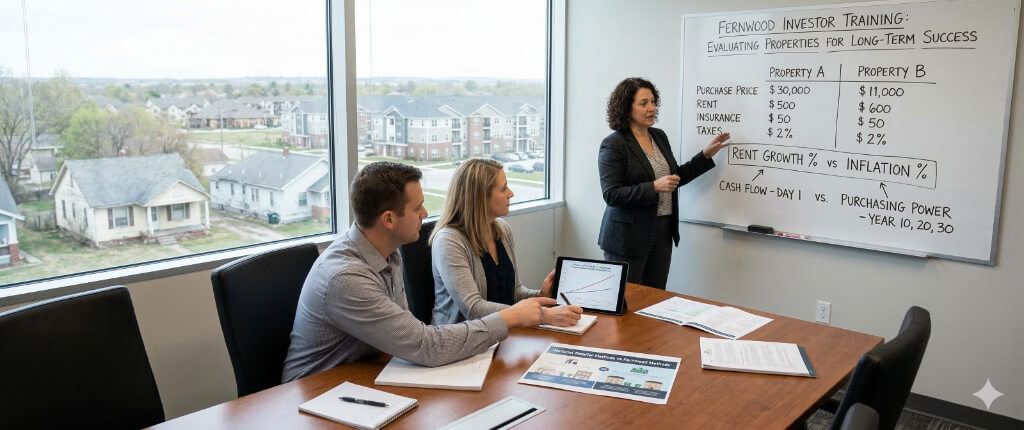
Before we start showing potential rental properties, we require new clients to complete two training sessions. Each session usually takes about 45 minutes to one hour.
Why?
Because you are not making a small decision. You are preparing to make a $350,000 to $450,000 investment decision, often in a city where you may not live.
Our job is not just to help you buy a rental property. Our job is to help you make a decision that has a high probability of working in the real world.
That requires more than listings, rent estimates, and spreadsheet formulas.
It requires a process.
Most Rental Property Advice Breaks Down in the Real World
A lot of real estate investing advice sounds simple. That is why it spreads so easily.
You may have heard advice based on:
- Rent-to-price ratios
- The 1% rule
- The 5% maintenance rule
- Day-one cash flow
- Generic return formulas
- Shortcuts promoted by books, podcasts, seminars, and online videos
The problem is not that every shortcut is useless. The problem is that shortcuts often leave out the details that determine whether a property actually performs.
You will not buy a “general” rental property in a “general” market.
You will buy a specific property, in a specific neighborhood, with specific taxes, insurance, tenant demand, repair risk, rent growth, and long-term ownership costs.
That is why we train our clients before we start presenting properties.
Example 1: Why Rent-to-Price Ratio Can Mislead Investors
One popular formula for comparing rental properties is the rent-to-price ratio:
Gross Annual Rent ÷ Purchase Price
At first glance, this seems reasonable. A property with higher rent relative to its price should be better, right?
Not always.
Consider two properties:
| Property A | Property B | |
|---|---|---|
| Purchase Price | $300,000 | $300,000 |
| Monthly Rent | $2,200 | $1,700 |
| Annual Insurance | $10,000 | $800 |
| Annual Property Tax | $9,000 | $2,000 |
Using rent-to-price ratio:
Property A:
$2,200 × 12 ÷ $300,000 = 8.8%
Property B:
$1,700 × 12 ÷ $300,000 = 6.8%
Based on rent-to-price ratio alone, Property A appears to be the better investment.
But once you include basic operating costs, the result changes.
Property A:
$2,200 × 12 − $10,000 − $9,000 = $7,400 per year
Property B:
$1,700 × 12 − $800 − $2,000 = $17,600 per year
Property B produces far more cash flow, even though its rent-to-price ratio is lower.
This is why we do not use rent-to-price ratio as a decision-making tool. It ignores operating costs, and operating costs matter.
In our training, we show clients how to compare properties using numbers that reflect real ownership.
Example 2: Why Maintenance Rules of Thumb Do Not Work
Another common shortcut is the “5% rule,” which says annual maintenance can be estimated as 5% of gross annual rent.
That sounds simple. But rent does not determine maintenance.
The property does.
Consider two examples.
Property A was built in the late 1950s. It rents for about $900 per month and is in poor condition. According to the property manager, annual maintenance is more than $2,000.
Property B was built in the 2000s. It rents for about $1,800 per month and is in excellent condition. I own this property, and my annual maintenance has been less than $350.

Using the 5% rule:
| Actual Annual Maintenance | 5% Rule Estimate | Error | |
|---|---|---|---|
| Property A | More than $2,000 | $540 | Understates by at least $1,460 |
| Property B | Less than $350 | $1,080 | Overstates by at least $730 |
The 5% rule gets both properties wrong.
It understates maintenance on the older, lower-rent property.
It overstates maintenance on the newer, higher-rent property.
This is backwards from reality.
In many cases, lower-rent properties are older, in rougher condition, and more expensive to maintain. Higher-rent properties are often newer, in better condition, and less expensive to maintain.
There is a better way to estimate maintenance, but it requires looking at the specific property, not applying a generic rule.
That is one of the things we teach in training.
Example 3: Why Day-One Cash Flow Is Not Enough
Many investors compare properties based only on day-one cash flow.
Cash flow matters. But day-one cash flow is not the whole story.
Rental properties are usually held for many years. If your goal is long-term financial independence, the future purchasing power of your rental income matters more than the first month’s cash flow.
Consider two properties:
| Property A | Property B | |
|---|---|---|
| Purchase Price | $300,000 | $300,000 |
| Monthly Rent | $2,200 | $1,700 |
| Annual Insurance | $800 | $800 |
| Annual Property Tax | $2,000 | $2,000 |
| Annual Rent Growth | 2% | 7% |
| Inflation Rate | 5% | 5% |
At purchase, Property A looks better.
Property A day-one cash flow:
$2,200 × 12 − $800 − $2,000 = $23,600 per year
Property B day-one cash flow:
$1,700 × 12 − $800 − $2,000 = $17,600 per year
Property A starts with higher cash flow.
But what happens over time?
Property A
| Year | Monthly Rent | Purchasing Power |
|---|---|---|
| 0 | $2,200 | $2,200 |
| 10 | $2,682 | $1,646 |
| 20 | $3,269 | $1,232 |
| 30 | $3,985 | $922 |
Property A’s rent rises in nominal dollars, but its purchasing power declines because rent growth is lower than inflation.
That creates a long-term income problem.
Property B
| Year | Monthly Rent | Purchasing Power |
|---|---|---|
| 0 | $1,700 | $1,700 |
| 10 | $3,344 | $2,053 |
| 20 | $6,578 | $2,479 |
| 30 | $12,941 | $2,994 |
Property B starts with lower cash flow, but its purchasing power increases over time because rent growth exceeds inflation.
If your goal is to live off rental income, this distinction matters.
Day-one cash flow tells you how a property performs at the beginning.
Hold-period analysis helps you estimate how the property may perform over many years.
We teach both.
What Our Training Covers
Our training is designed to help clients evaluate rental properties the way we evaluate them.
We do not start with listings. We start with the same question successful national retailers ask before choosing a store location:
Who are we trying to serve, and what location and product best match that customer?
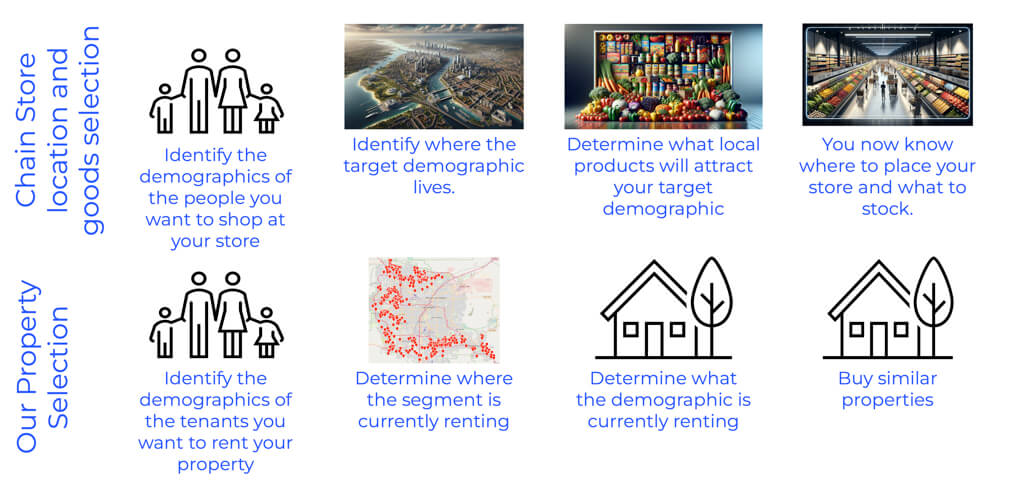
We cover:
- How we identify properties worth reviewing
- How we estimate rent
- How we think about tenant demand
- How we estimate maintenance provisions
- How we compare properties using real operating costs
- Why day-one cash flow is only part of the analysis
- How rent growth, inflation, and time affect long-term purchasing power
- How our process reduces avoidable mistakes before an offer is made

Fernwood’s preparation process teaches investors how we select cities, tenant segments, properties, and renovation plans, then moves into the kickoff meeting, ownership structure, and property management setup.
The goal is not to make real estate investing complicated.
The goal is to make the decision clear.
Most of the process is simple once you understand what matters and what does not.
Why We Teach Before We Show Properties
We do not want clients looking at properties before they understand how the properties should be evaluated.
Without the right framework, it is easy to focus on the wrong things.
A property may look attractive because the rent is high.
But the operating costs may be too high.
A property may look safe because the day-one cash flow is strong.
But the rent growth may not keep up with inflation.
A property may look inexpensive.
But the tenant segment, condition, or long-term maintenance risk may make it a poor investment.
Training helps clients avoid those mistakes.
It also makes the property selection process more productive. When we do start reviewing opportunities, clients understand why we reject certain properties and why we recommend others.
Our Process Is Built From Real Experience
Over the past 17+ years, we have helped clients acquire more than 600 investment properties.
Most of our clients do not live in Las Vegas. Many live in other states or other countries. They rely on us because they need more than access to listings. They need a local process that has been tested through real market conditions.
Our approach is based on a simple idea:
A rental property is not just a house.
It is a long-term income system.
The property, tenant segment, location, operating costs, rent growth, and management process all have to work together.
That is what our training is designed to teach.
We Want You to Succeed
Popular real estate education often focuses on shortcuts, secrets, and rules of thumb.
We do not.
We teach the process we use in the real world.
Before you buy a rental property, you should understand how to evaluate the investment, how to compare properties, and how to think about long-term income.
That is why we require training.
Not to slow you down.
To help you make a better decision.
Want to Know Whether Our Process Is a Fit?
We do not start by showing properties. We start by understanding your goals.
If you are considering investing in Las Vegas rental property, schedule a discovery call. We will discuss what you are trying to accomplish, answer your questions, and determine whether our process is the right fit.