
[Image generated with GPT]
A 1031 exchange may make sense when you have significant equity in an investment asset that is no longer meeting your needs. Some of the reasons an investor might consider an exchange:
- Income is failing to keep pace with inflation.
- Regulatory changes, such as rent control, limit your ability to increase rents or remove non-performing tenants.
- Ongoing tenant issues, including frequent turnover, late payments, property damage, or evictions.
- A deteriorating area may negatively affect tenant quality, rent growth, or property values.
- Significant deferred maintenance requires substantial capital to correct.
- Diversifying investment risk by exchanging one property for multiple properties.
- Improving income reliability by moving equity into properties that attract more reliable, long-term tenants.
A one-to-one exchange may sound straightforward enough. Sell one property, identify a good replacement within the 45-day window, and close on it within 180 days. Should be achievable without too much sweat.
When the value of the relinquished property is significantly higher than a preferred replacement property, such as trading a $1M Las Vegas 4-plex for $400k single-family rentals (much better performance), you will need multiple replacement properties, all identified, evaluated, secured, inspected, and financed (if necessary) at the same time. Without a process, things can easily get chaotic or overlooked, which can invalidate the entire exchange.
This post is a case study of how we successfully completed a one-to-six exchange without breaking the client or our team.
A One-to-Six Exchange, Completed in 30 Days
This is not our first one-to-six exchange. Our record was one-to-seven. But this one was completed in the shortest timeframe, even with a complication during the process.
Note: We take our clients’ privacy very seriously, so I’ll use approximate numbers rather than specific property details.
The Goal
The client’s goal is to exchange one $1.1M property with chronic tenant issues for as many single-family rentals as initial cash flow allows, and utilize DSCR financing to grow their portfolio as rapidly as possible with minimal risk.
Based on prevailing interest rates and the first-year rents these single-family rentals typically generate, the math worked out to 6 properties in our target profile.
As such, we had to use the 95% 1031 exchange rule because we are identifying more than three properties, and more than 200% of the value of the relinquished property. 95% is a more aggressive and riskier rule because you must close at least 95% of your identified properties, or the entire exchange is invalid. [Source]
The Specifics
- Relinquished property proceeds: $1,150,000
- Debt: None
- Minimum reinvestment: More than $1,150,000
- Property went under contract: 6/1/2026
- Buyer contingencies end: 7/10/2026
- Relinquished property closes: 7/22/2026
- 45-day identification period begins: 7/22/2026
- 45-day identification deadline: 9/5/2026
- 180-day end of 1031 exchange: 1/18/2027
- Replacement properties: Six single-family homes between $360,000 and $440,000
- Financing: DSCR loans for all six replacement properties
The Execution
The client stated, “You are the only team in town that I know can pull this off.”
Why? Because we’ve drilled the two major components of the execution.
Identify sufficient replacement properties
If you wait until the relinquished property closes to start looking for replacements (which is how a 1031 exchange is commonly done), you will run into two risks:
- 45 days isn’t enough time to find and fully evaluate six replacement properties. You end up choosing properties because they fit the 45-day window, not because they are the best investments. On average, we evaluate 6 or 7 pre-filtered candidates before we approve one. And we don’t always get all the properties we offered on.
- Problems often surface during due diligence. Title issues, inspection findings, or other problems can make a property unsuitable or impossible to purchase. And you are out of time to look for a replacement.
So, over time, we moved away from the typical process to give the team more time to find good replacement properties, complete due diligence, and still have time to replace a property if something goes wrong (which was exactly what happened during this project).
Below is the timeline we followed. We start searching for replacement properties as soon as the relinquished property is under contract. By starting early, we increased the time available to find and fully evaluate replacement properties from 45 days to about 110 days.
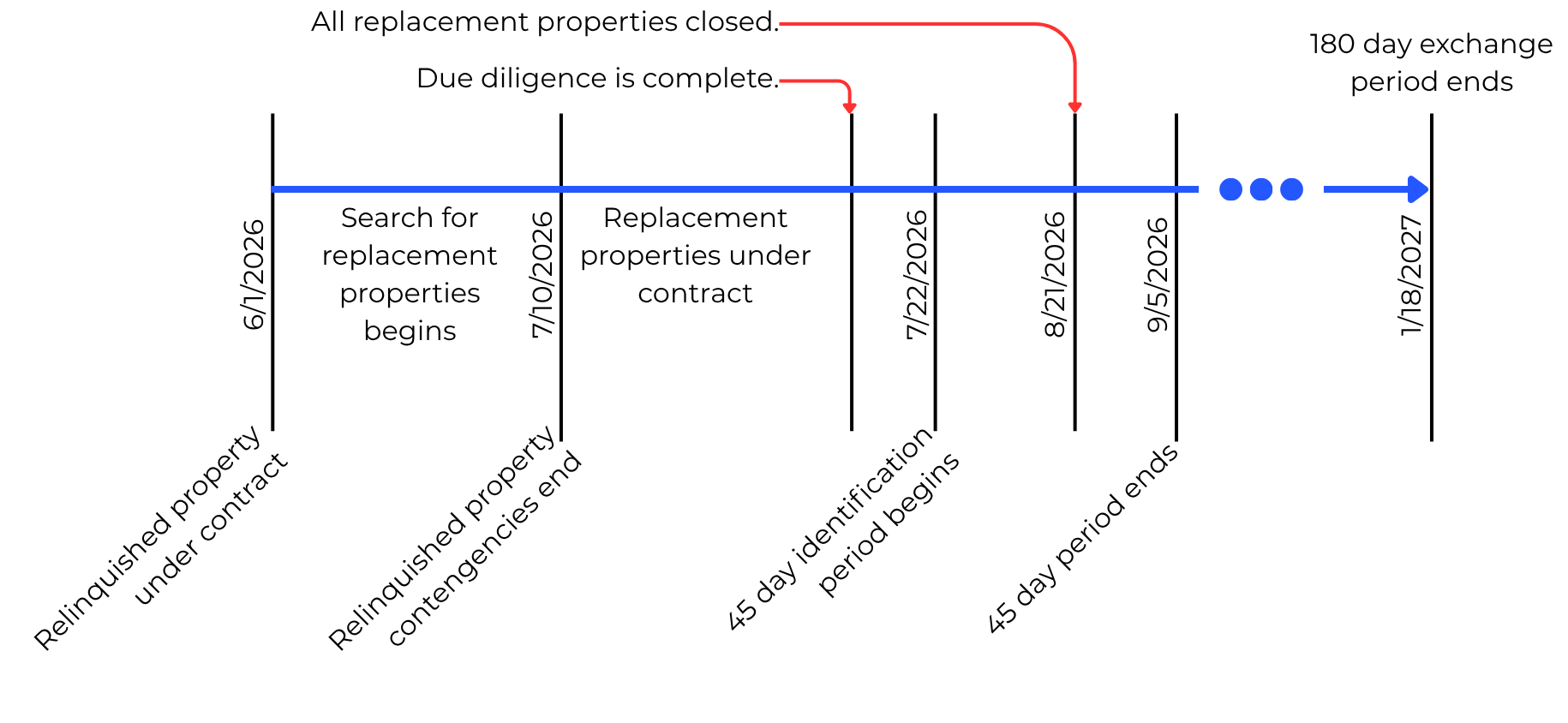
Once the buyer’s contingencies on the relinquished property end, we start placing the replacement properties under contract. We cannot close on these properties until after the relinquished property closes, but we use that time to do the work.
We put the first replacement property under contract about a week before the relinquished property closed. Properties 2-6 were put under contract in the subsequent 10 days or so.
However, inspections uncovered significant defects in the first property. The decision was made to cancel. That was on the day the relinquished property closed. A replacement was successfully secured a week later, 7 days into the 45-day identification window.
Manage multiple closing processes simultaneously
We have a 60+ item checklist to ensure a financed purchase escrow runs smoothly.
Although we attempted to use one title and escrow company across all 6 escrows, it is not always possible depending on the negotiated terms of the purchase contracts. For this project, we ended up working with 3 title companies.
So, we must manage the coordination between the client, the QI, the title companies, and the lender across all 6 escrows simultaneously. Timelines for due diligence, title clearance, HOA evaluation, appraisal, loan approval, and funding through the QI must all be closely monitored and met for each escrow.
Because of the processes and tools we built to minimize issues during the closing process, we were able to complete due diligence for 7 properties and closed on 6, all within the contract timelines without scrambling.
The Result
The last of the 6 replacement properties was funded and closed on 8/21, 30 days into the identification window. The entire exchange from one $1.1M relinquished property to six replacement properties totaling $2.37M was completed, not just identified, well within the 45-day identification window.
Summary
A one-to-six 1031 exchange requires more than finding six properties within 45 days. You need time for due diligence, financing, multiple closings, and replacing properties that fail inspection or have title issues.
We started searching as soon as the $1.1M relinquished property went under contract, expanding our effective search period from 45 days to about 110 days. We completed due diligence on seven properties, canceled one after inspection, and secured its replacement seven days into the identification period.
The client ultimately exchanged one $1.1M property for six single-family rentals totaling $2.37M. The final property closed just 30 days after the relinquished property.
The lesson: Don’t let the 45-day deadline determine what you buy. Start early and leave yourself enough time to walk away from a bad property. Work with an experienced team with proven processes and tools to complete complex projects.
Planning a complex 1031 exchange? Talk with our team before your relinquished property closes so there is enough time to identify, evaluate, and secure the right replacement properties.