
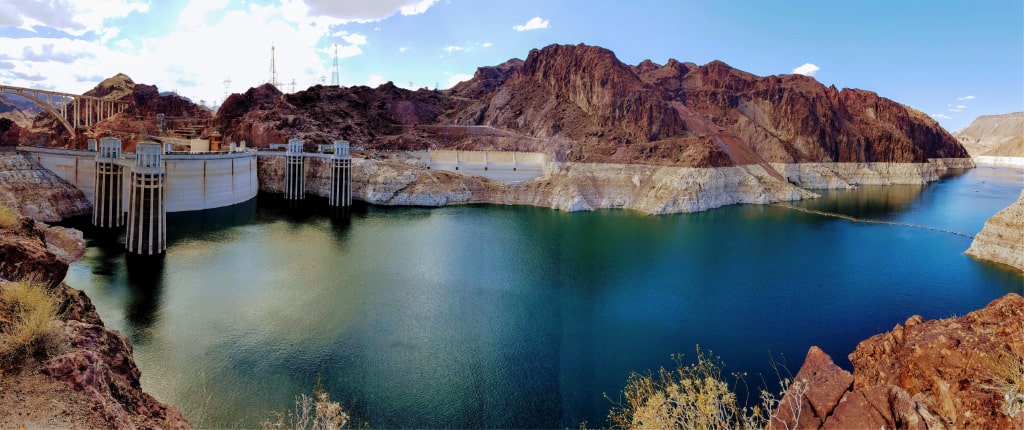
Benoit Debaix – Unsplash
I am regularly asked whether Las Vegas is running out of water. It is a fair question, and an important one if you are thinking about living or investing here. The short answer: Las Vegas is the most water-secure major city in the desert Southwest, and that is not optimism — it is the result of roughly $1.5 billion of infrastructure built specifically for the situation we are in today.
Below I walk through the short-term picture, what falling lake levels mean for power and your utility bill, the long-term outlook, and what changes at the end of 2026.
Quick facts (June 2026)
- Lake Mead elevation: ~1,050 feet, projected to approach the all-time low (~1,040 ft) this summer and possibly ~1,020 ft by July 2027.
- Nevada’s Colorado River allocation: the smallest of any Lower Basin state — about 1.8% of the river — and currently reduced under a Tier 1 shortage (a 21,000 acre-foot/year cut).
- Per-capita water use: down 58% since 2002, even as the population grew by roughly 800,000 people.
- Las Vegas access depth: its primary intake reaches ~875 feet — below Lake Mead’s “dead pool” elevation of 895 feet.
Is the short-term supply secure? Yes.
Here is a quote from a that sums it up well:
But Las Vegas’ water won’t be affected. The water authority wisely built an intake valve into the bottom of the lake years ago. If you don’t believe my optimism, take it from John Entsminger, the SNWA’s [Southern Nevada Water Authority] general manager. He called Las Vegas “the most water-secure municipal area in the Colorado River Basin.”
That “intake valve at the bottom of the lake” deserves a name, because it is the whole reason Las Vegas can be confident. The Southern Nevada Water Authority (SNWA) built two things:
- Intake No. 3 — the “Third Straw” (online in 2015): a drinking-water intake that draws from deep in Lake Mead, below the older intakes that risk being stranded as levels fall.
- The Low Lake Level Pumping Station (online in 2022): pumps capable of moving up to 900 million gallons a day from those deep waters to treatment facilities.
Together, these let Las Vegas keep drawing water even below Lake Mead’s dead pool — the 895-foot elevation at which no water can pass through Hoover Dam at all. Because the city’s primary pump reaches down to about 875 feet, Las Vegas would still have access to Lake Mead even in a scenario where downstream California and Arizona cannot pull water through the dam.
As Entsminger put it: “We invested $1.5 billion in the third intake and the low-level pumping station for a reason. We knew very well that this day could come… the people of Las Vegas can take comfort in the fact that they are the most water-secure city in the desert Southwest.”
Hoover Dam and your power bill
This is the part of the story that has moved from “someday” to “now.”
When Lake Mead drops below 1,035 feet, Hoover Dam’s hydropower generating capacity falls by roughly 70% — twelve of its seventeen turbines are not designed to run in low-water conditions. Federal forecasts released in 2026 suggest Lake Mead could cross that 1,035-foot threshold within about a year, and Hoover’s output could fall by as much as 40% by fall 2026.
Here is the good news for residents: Las Vegas is one of the only major U.S. cities with dual electric power sources — Hoover Dam and California. We do not face the lights going out. What we may face is higher utility bills, because power purchased from California to replace lost Hoover generation costs more. I expect that to show up on bills if lake levels keep falling. It is a cost increase, not a crisis.
The long-term outlook
When people worry about water, they are usually worried about the next 20 or 30 years. Here is how I think about it.
History is instructive. Around 1890, research concluded the water supply would cap Los Angeles’ population at about 400,000. Everyone agreed; end of story. Then William Mulholland, head of the LA water district, proposed the Los Angeles Aqueduct — a 233-mile system moving water from the Owens Valley to the San Fernando Valley. To this day, that aqueduct supplies a large share of LA’s water. The point: when a major city needs water badly enough, engineering and capital solve the problem.
The economics make this almost inevitable for Las Vegas. About 15 years ago, a study estimated the cost of a pipeline from Las Vegas to a water source in Northern Nevada at roughly $2 billion. Whether the real number is $2B, $4B, or $20B does not change the conclusion. Resorts World alone cost $4.3 billion to build, and Las Vegas has more than $22 billion in major projects under way and over $8 billion in late planning stages. No one shuts down a trillion-dollar economy over a few billion dollars of pipe.
There is also an enormous amount of water “hiding in plain sight” in the form of grass. About 60% of Southern Nevada’s water is used outdoors, much of it watering lawns. Grass in the Mojave Desert never made much sense, and it is now disappearing — not by hope, but by law. Nevada’s Assembly Bill 356 bans non-functional turf in the Las Vegas Valley starting January 1, 2027. SNWA has set a goal of 86 gallons per capita per day by 2035, and the region has already cut per-capita use by 58% since 2002 while growing dramatically. In other words, the lever I predicted years ago — raise the cost of water, lose the lawns — is already being pulled.
I also take comfort in what large, sophisticated investors are doing. Companies pouring billions into Las Vegas did their homework on water and every other risk before committing the capital. I trust that research.
A case in point: Google’s data center
Consider Google. Since breaking ground on its Henderson data center in 2019, Google has committed more than $2.2 billion to Nevada, including a recent $400 million expansion. You do not invest that kind of money in the desert without first answering the obvious question: will there be enough water, for decades, to run it?
Data centers use water for cooling, and Google’s Henderson campus is often cited as Southern Nevada’s “thirstiest,” consuming about 352 million gallons in 2024. That sounds alarming until you look at what is actually happening, because it is a good illustration of how the region manages water — and why I am not worried.
First, the rules adapted. Henderson’s facility opened in 2020 using evaporative cooling, which loses water to the air permanently. Southern Nevada has since banned evaporative cooling for new buildings, data centers included. New facilities must use closed-loop systems that recycle their water, or air cooling that uses very little. Google is now deploying advanced air-cooling in its new Nevada builds and liquid cooling for its densest AI workloads. The single most water-intensive use case showed up, the region tightened the rules, and the industry adjusted — exactly the mechanism I expect to govern water here for years to come.
Second, Google is putting water back. The company has funded $4.7 million in watershed and water-stewardship projects in the Las Vegas Valley and the Lower Colorado River Basin, and it reports replenishing more water to the Colorado River Basin than the freshwater its Clark County operations consume. Local governments are also setting limits — Henderson has weighed pausing new data centers — which is the system doing its job.
The takeaway for a homeowner or investor is simple. One of the most analytically rigorous companies on earth studied Southern Nevada’s long-term water supply, decided it was sound enough to anchor billions of dollars of infrastructure, and is structuring its operations to keep it that way. That is a more meaningful vote of confidence than any forecast I could offer.
What changes at the end of 2026
This is worth watching, because the rules that govern the Colorado River are being rewritten right now.
The 2007 Interim Guidelines and the 2019 Drought Contingency Plans — the agreements that determine how shortages are shared among the seven basin states, the tribes, and Mexico — expire at the end of 2026. The Bureau of Reclamation released a draft Environmental Impact Statement in January 2026, and final “post-2026” operating guidelines are targeted for later this year. The Lower Basin states (including Nevada) have proposed tying water-use reductions to total system storage rather than Lake Mead’s level alone.
What does this mean for a Las Vegas homeowner or investor? Likely modest, additional conservation requirements and continued pressure on outdoor water use — not a threat to the tap. Nevada’s allocation is tiny to begin with, and the region has already proven it can grow while using less.
Bottom line
Las Vegas’ water supply is secure for the foreseeable future. The infrastructure to keep the taps running even below dead pool already exists and is paid for. The most likely near-term effect of the drought on a typical resident is a higher power bill, not a water shortage. Long term, the need will be met — through conservation, pricing, and, if necessary, engineering, exactly as every major Western city has done before. How it gets solved will be worked out over the coming years. That it will be solved, I have little doubt.
Frequently asked questions
Is Las Vegas running out of water? No. Las Vegas draws from Lake Mead through deep intakes that function even below the dam’s dead-pool elevation, and Nevada’s allocation is the smallest of the Lower Basin states. SNWA’s general manager calls it “the most water-secure city in the desert Southwest.”
Will falling Lake Mead levels turn off my tap? No. The “Third Straw” and Low Lake Level Pumping Station were built specifically to keep delivering water at very low lake levels — down to about 875 feet, below the 895-foot point where water stops flowing through Hoover Dam.
Will my utility bill go up because of the drought? Possibly. As Lake Mead falls, Hoover Dam generates less hydropower. Las Vegas can buy replacement power from California, but that power costs more, which may raise electric bills over time.
What happens to lawns in Las Vegas? Non-functional grass is being phased out. Nevada law (AB356) prohibits non-functional turf in the Las Vegas Valley starting January 1, 2027, and rebate programs already pay property owners to remove grass.
Should water concerns stop me from investing in Las Vegas real estate? In our view, no. The water supply is secured by existing infrastructure, the region has cut per-capita use 58% while growing, and tens of billions in private capital continue to flow into the valley. Water risk is real to plan around, but it is not a reason to avoid the market.
Sources