



In This Report
-
Cost Segregation for Single-Family Rental Properties
-
Potential Investment Properties
-
Market Trends
-
About the FERNWOOD Team
Cost Segregation for Single-Family Rental Properties
Before I continue, know that I am an engineer. I am not a financial advisor, accountant, nor do I have training in cost segregation. This post is intended only to highlight possibilities. Consult with a tax professional before making any decisions.
, this week I will go deeper into cost segregation as a strategy to maximize tax benefits and its potential financial impact.
You can legally accelerate thousands of dollars in tax deductions to the first few years of owning a rental property instead of amortizing it over 27.5 years. That’s exactly what cost segregation does, and it’s no longer just for large commercial buildings.
What Is Cost Segregation?
When you buy a rental property, the IRS makes you depreciate it slowly. 27.5 years for residential properties, 39 years for commercial. But here’s the thing: not every part of your property needs to follow that timeline.
How It Works
A cost segregation study separates your property into different categories based on IRS-defined “useful life”:
-
5-Year useful life components: Carpets, appliances, landscaping, decorative light fixtures.
-
15-Year useful life components: Driveways, fences, sidewalks, land improvements.
-
27.5-Year useful life components: The structural elements like walls, roof, and foundation.
By reclassifying these shorter-life assets, you can claim larger depreciation deductions in the first several years rather than spreading them evenly over nearly three decades.
Tax Savings
For example, suppose you purchase a single-family rental for $300,000, with $240,000 allocated to the improvements (the land doesn’t depreciate). A cost segregation study might reclassify $50,000 to $80,000 into the 5-year to 15-year categories, adding significant deductions in those years.
This front-loaded depreciation creates substantial tax savings, especially when combined with bonus depreciation rules that may allow you to deduct a significant percentage immediately. For investors with high W-2 income, this can offset your tax liability in ways that traditional depreciation simply cannot. ,
Is It Worth It for Single-Family Homes?
It depends on your income and the property’s price. For example, does it make sense to spend $6,000 on an engineering cost segregation study to save $10,000 in taxes? Probably not. Plus, anything out of the ordinary (W2 income with standard deductions) is more likely to trigger an audit. What if you could spend $6,000 and save $75,000 in taxes? Yes, it absolutely does make sense, despite the increased risk of an audit.
The probability of an audit varies by cost segregation study quality as does the cost for the study (I mentioned the cost ranges in ). There are three basic categories:
-
DIY software: This is the most likely study to not stand IRS scrutiny: , , ,
-
Hybrid: This is better than DIY software but not as solid as a full engineering study: , , ,
-
Engineering-based: This is the “gold” standard: , , ,
This is your classic risk-versus-reward decision. Save money with a low-cost DIY software study, pay much more for a gold-standard engineering-based study, or split the difference with a hybrid approach?
Note: The IRS doesn’t publish a numeric “tier list,” but the Cost Segregation Audit Techniques Guide (ATG) clearly defines what it calls a “quality” cost segregation study and lists the main methodologies it sees, from highest‑ to lowest‑quality approaches. .
Important Considerations
The cost segregation delivers the best return when you have significant taxable income to offset, you plan to hold the property long-term, or you’re purchasing multiple properties in a single year.
-
Cost segregation doesn’t eliminate taxes. It defers them. Think of it as moving tax payments from today to the future, when you sell the property.
-
When you eventually sell, you’ll face depreciation recapture (the IRS wants its money back) at ordinary income rates for the accelerated portion. Additionally, if your income exceeds certain thresholds, passive activity loss rules may limit your ability to use these deductions immediately unless you qualify as a real estate professional.
-
These are complex tax strategies. The rules matter. The timing matters. Your overall tax situation matters.
Getting Started
If you’re interested in exploring cost segregation, consult with a CPA or tax advisor who specializes in real estate taxation, not your general tax preparer. You need someone who lives and breathes real estate tax strategy.
They can help you determine whether the strategy aligns with your overall tax situation and financial goals. They’ll run the numbers, evaluate your specific circumstances, and tell you whether the juice is worth the squeeze.
Sources
-
The House report and statutory text for the contains the language for the “temporary additional increase in standard deduction” and related provisions that reduce regular income.
-
: The official IRS guide outlining cost segregation methodologies, property classification standards, and audit guidance. Internal Revenue Service.
…Eric
If you’re interested in exploring how the current Las Vegas market conditions could align with your goals, please use the link below to schedule a time that works best for you.
Potential Investment Properties
Below is a link to this month’s list of candidate investment properties. Our proprietary data mining software selected these candidate properties from thousands of available properties, and this is just the first step in our multi-step validation process, as shown below. 
Market Trend
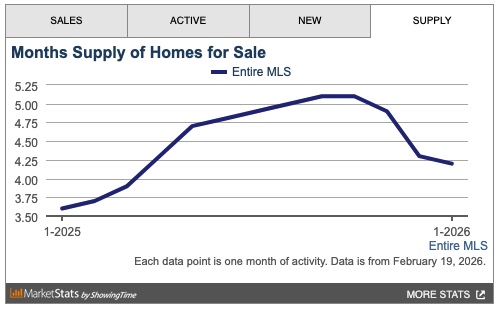
Below are charts from our latest trailing 13-month market report, which includes January data. Remember that this data is only for our target property profile, not the entire metro area. The chart below, from the MLS, includes ALL property types and price ranges. The overall inventory is trending down.
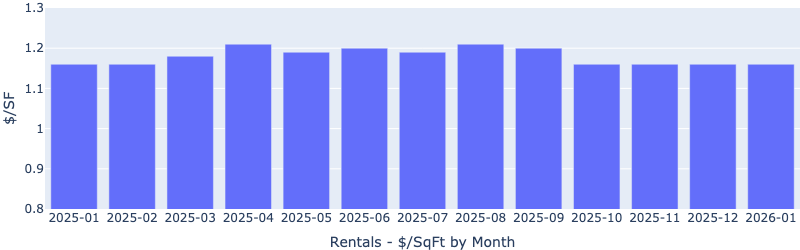
Rentals – Median $/SF by Month
Rents were unchanged again MoM. It is very unusual for rents to hold steady throughout the holiday months, traditionally the slowest time for the rental market.
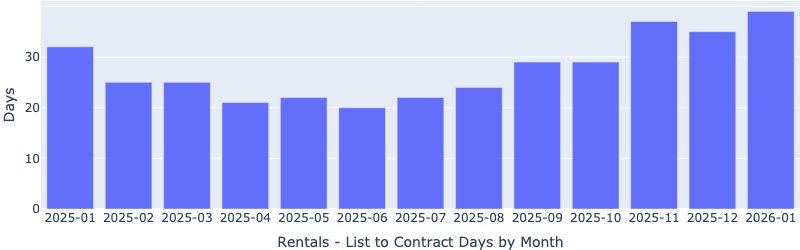
Rentals – Median Time to Rent by Month
Median days to rent increased MoM, conforming to the seasonal trend.
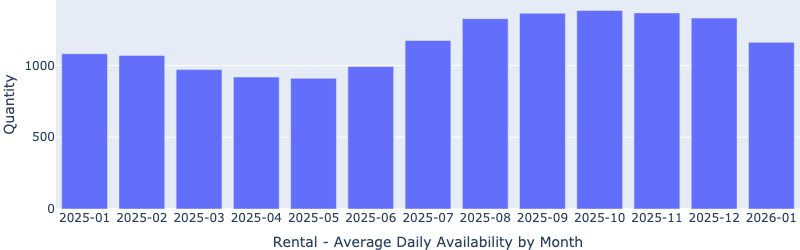
Rentals – Availability by Month
The number of homes for rent decreased MoM, which is expected for the time of the year.
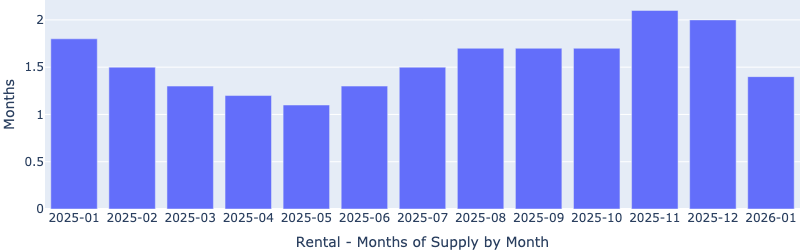
Rentals – Months of Supply
Rental inventory decreased significantly MoM, now at 1.4 months, indicating a landlord’s market.
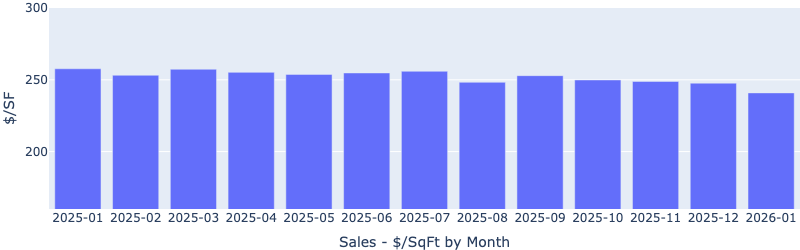
Sales – Median $/SF by Month
Prices decreased MoM, perhaps finally catching up to the holiday “slump” that did not occur during the holiday months.
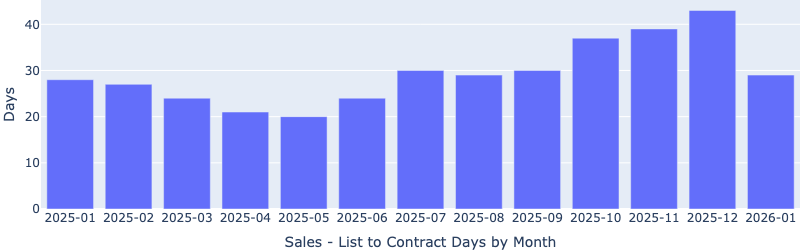
Sales – List to Contract Days by Month
Median days on the market decreased significantly MoM, likely the result of the price decrease.
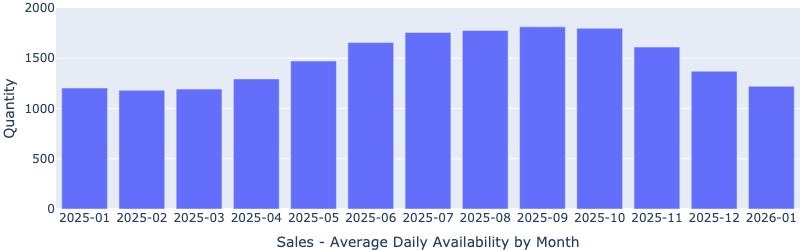
Sales – Availability by Month
The number of properties for sale has been steadily decreasing since September, which bucks the “usual” seasonal trend (it usually goes up during the holiday season).
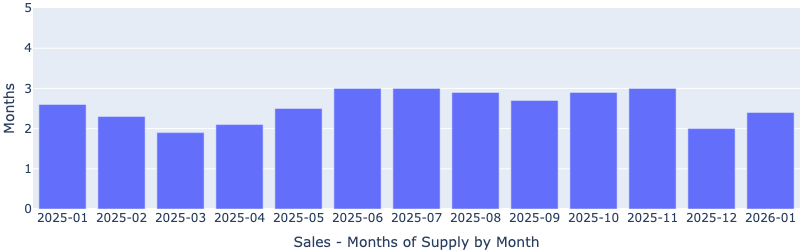
Sales – Months of Supply
Sales inventory has ticked up MoM to just below 2.4 months, still a seller’s market.
About the FERNWOOD Team
We Help Busy Professionals Build Wealth and Reliable Income through Strategic, Data-driven Real Estate Investments in Las Vegas. Here is what our clients have to say about us:
-
For the last 17+ years, we’ve helped clients build highly reliable, passive income streams through real estate that they will not outlive. Several are now retired and living entirely on their rental income. Most never invested in real estate before they started working with us, and most live in other states or countries. Below is a two-minute video of the services we provide.

Want to know what we can do for you?
© 2005-2025 Cleo Li and Eric Fernwood, all rights reserved.