
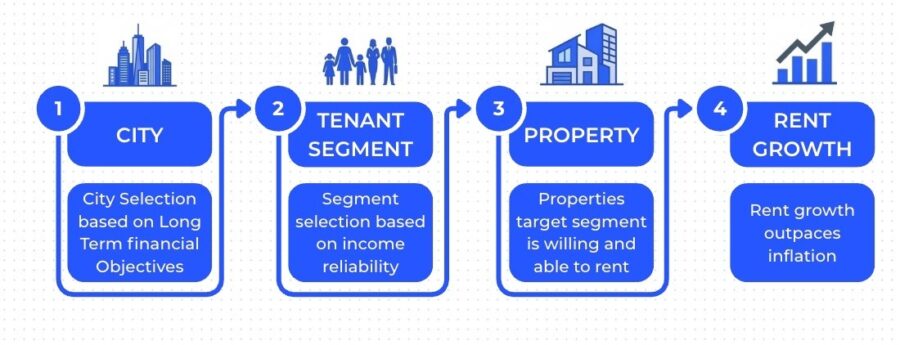
One of the most common questions investors ask is:
How is Fernwood’s process different from the investing strategies I read about online?
Most popular real estate investing advice focuses on two ideas:
-
maximizing initial cash flow
-
finding properties at a discount
This property-centric approach overlooks the most important factor in rental investing.
Tenants pay the rent, not properties.
No property in the history of the world has ever paid rent. A property is simply a container that a tenant occupies. Your financial success as a rental property investor depends on the reliability of the tenant occupying that property.
Low prices or discounted properties do not create rental demand. In many cases they signal the opposite, a lack of demand from stable tenant segments.
When investors focus primarily on property price, the results tend to be inconsistent. Some properties perform well. Others experience high tenant turnover, long vacancies, or maintenance problems.
Learning from National Retailers
When I started my investor services business in 2005, I studied many real estate investing “gurus.” Much of what I found were personal opinions presented as universal truths.
As an engineer, I prefer systems built on process and evidence.
So instead of studying individual investors, I studied the commercial real estate world. Specifically, how successful national retailers choose cities, store locations, and location-specific offerings.
Retailers such as grocery chains, big box stores, and restaurants do not begin by asking:
-
Is the building cheap?
-
Does the location feel promising?
Instead they begin with their target customer.
They identify:
-
cities where their target demographic lives
-
neighborhoods where that demographic is concentrated
-
the products and services that attract those customers
Only after understanding the demographics do they choose store locations.
This process is systematic and repeatable.
It also works extremely well.
The Fernwood Tenant-Centric Framework
We adapted this demand-driven approach to residential real estate investing.
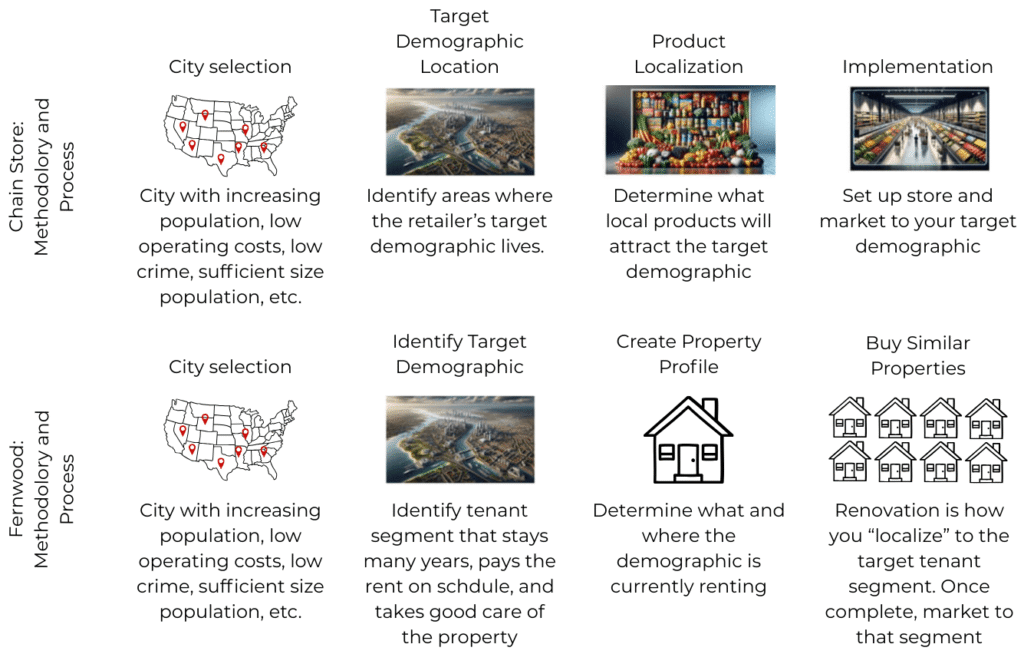
Retailers follow a process like this:
-
Select a city with strong population growth and economic outlook.
-
Identify neighborhoods where their target customer demographic lives.
-
Determine which products and services attract that demographic.
-
Place stores near those customers and stock the appropriate offerings.
Fernwood follows a similar process for rental investing.
-
Select cities with strong population growth and long-term economic expansion.
-
Identify tenant segments that are likely to stay for many years, pay rent on time, and take good care of the property.
-
Study the types of properties those tenants currently rent.
-
Purchase properties that match those tenant requirements.
This approach is tenant-centric.
Instead of starting with the property, we start with the tenant.
Why This Approach Works
Every tenant segment has specific housing requirements. These requirements typically include factors such as:
-
price range
-
home size
-
neighborhood characteristics
-
proximity to employment
-
school districts
Tenants only consider properties that meet all of these requirements. For example, see the illustration below. The top shows a tenant segment and their housing requirements. Below are four properties. Although the properties are similar, only one matches all the segment’s housing requirements—and will be the only one they consider.
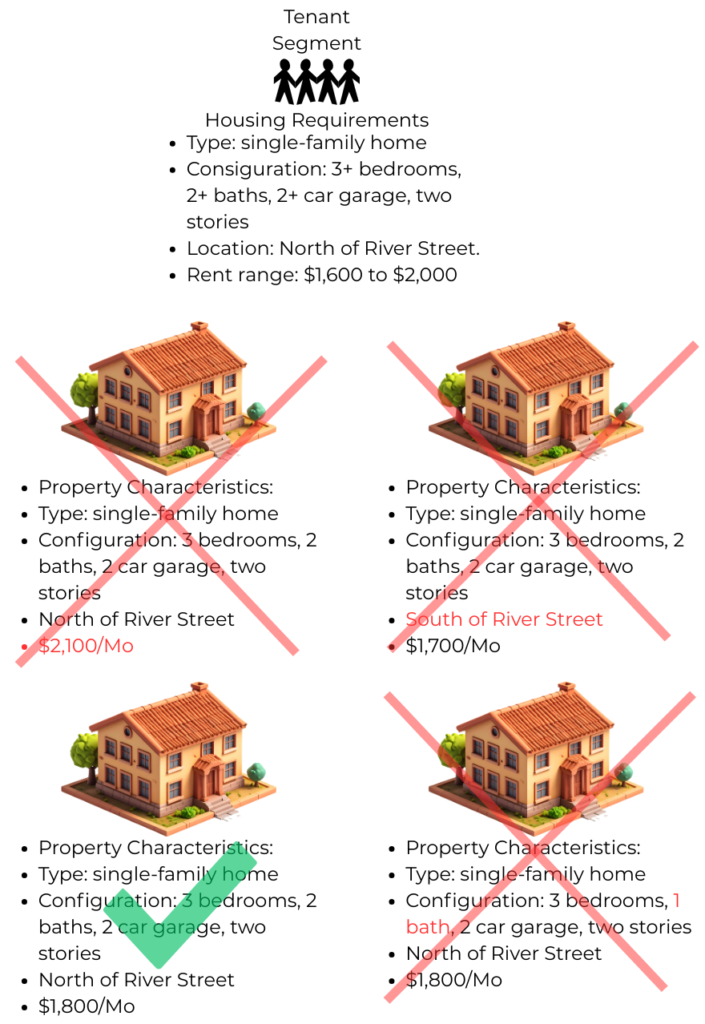
Two homes may look very similar to an investor, but if only one matches the housing requirements of a reliable tenant segment, that will be the property that attracts long-term tenants.
By selecting properties that match the housing requirements of reliable tenant segments, investors dramatically improve the likelihood of consistent occupancy and reliable rental income.
The Risk of Property-Centric Investing
When investors purchase properties primarily because they appear inexpensive or discounted, they unintentionally select for the tenant segment that is attracted to those properties.
If that tenant segment exhibits:
-
higher job instability
-
shorter tenancy
-
more frequent moves
then the property will likely experience higher turnover and more operational challenges.
The property itself cannot change the tenant segment it attracts.
For this reason, selecting the right tenant segment is often the most important decision in rental property investing.
Achieving Reliable Rental Performance
Successful national retailers begin with the customer they want to serve and work backward to store locations and product selection.
Rental property investors should take a similar approach.
When you begin with a reliable tenant segment and choose properties that match that segment’s housing requirements, you significantly improve the chances of achieving long-term income reliability.
In rental investing, the tenant determines the success of the property.