
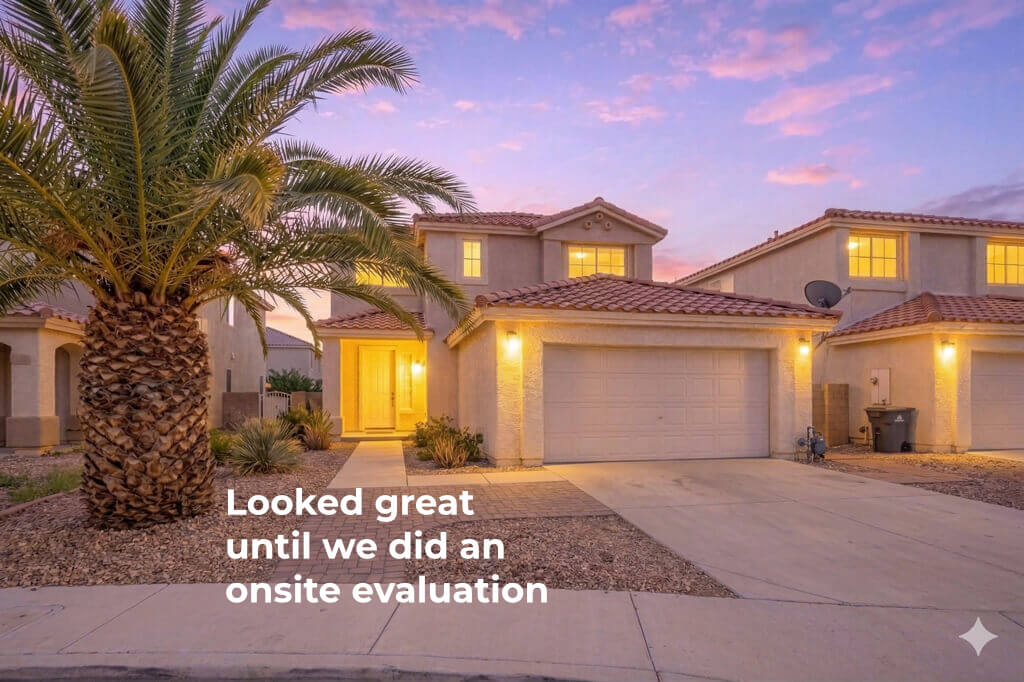
At first glance, this looked like the kind of rental property investors want to find.
It was in Silverado Ranch, one of the more desirable areas we like in Las Vegas. It was a 1,520 square foot, two-story, 3-bed, 3-bath single-family home with a 2-car garage. The condition was excellent, and the asking price of $409,000 looked attractive for the location, size, and finish level. Based on the property manager’s rent estimate, it even appeared capable of producing positive cash flow with 30% down at a 6.25% interest rate. In today’s market, that is rare.
So why did we reject it?
Because getting to a good investment takes more than finding a property with decent numbers. Before we ever recommend an offer, a property has to pass a multi-step screening process designed to answer one question:
Will this property attract the type of tenant that produces reliable, long-term income?
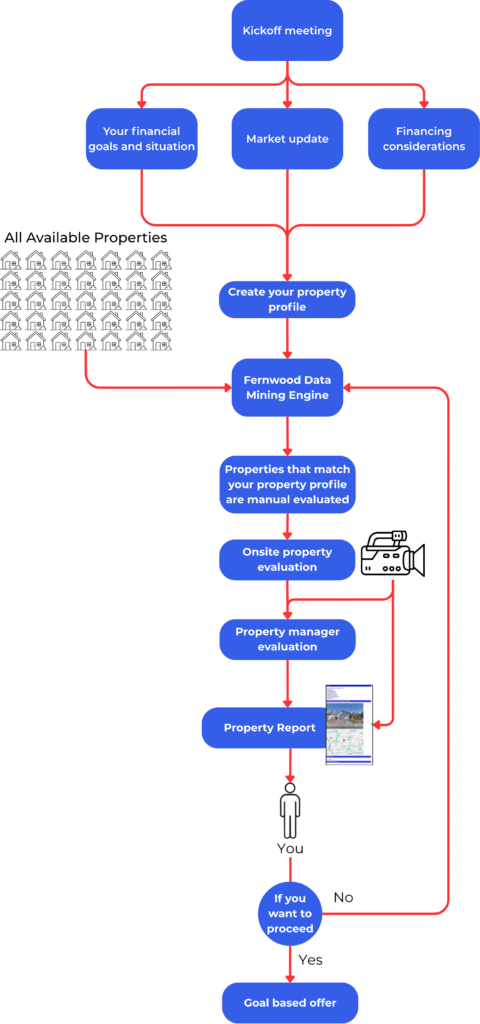
The diagram below shows that pre-offer process. It is the filter a property must pass before we ever get to pricing and offer terms.
Our pre-offer process
The process starts with a kickoff meeting. The purpose is to create your property profile, which is a physical description of the type of property that best matches your investment goals, budget, renovation tolerance, and preferences.
From there, the Fernwood Data Mining Engine screens the market. It removes properties that are unlikely to attract our target tenant segment and narrows the field to a manageable number of candidates. Today, the engine checks each property against about 40 characteristics. That includes basics such as location, price range, property type, and configuration, plus many smaller details shaped by years of observing tenant behavior. On a typical day, more than 1,000 MLS listings may go in, and fewer than 150 may remain worth further review.
The next step is manual evaluation. Your account manager reviews the remaining properties, compares them against your property profile, and estimates rent and renovation range based on recent comparable data, MLS photos, and experience. About 60% of the properties that pass the data-mining stage still get rejected here, usually because the expected ROI is not strong enough.
If a property survives that stage, we visit it in person. This is where many properties fail. We evaluate the subdivision, the immediate neighbors, the exterior, and the interior from a tenant’s point of view. We record a video walkthrough and note anything that could hurt rent, delay leasing, or reduce the quality of tenant we can attract. That video is then reviewed by the property manager, who provides an updated rent range, time-to-rent estimate, recommended renovation scope, and comments on the property’s strengths and weaknesses as a rental. All of that is rolled into the Property Report.
Only after that do we decide whether the property is worth pursuing.
Case study: why we passed on this property
This property passed the early stages with flying colors.
It was in a strong area. It matched the right general configuration. The seller had updated it nicely. The projected rent range looked good. The numbers looked better than average for today’s market. On paper, it seemed promising.
Then we visited it.
Two issues changed the decision.
The first problem was the neighboring properties. They were visibly less maintained than we want to see for this tenant segment. As the property manager put it, the neighboring homes did not present well enough to support strong appeal to our target tenant. That matters because tenants do not rent based only on the inside of the house. They also react to the street, the immediate surroundings, and how the property feels when they arrive.
The second problem was the floor plan. There were two steps up to the front door, then two steps down from the entry into the main living area. That layout tends to perform poorly. In addition, the primary bath had only one sink, where tenants at this price and rent range would usually expect two. These may sound like small details, but small details matter when you are trying to attract stable, long-term tenants.
That combination was enough for us to remove the property from further consideration.
This was not because the house was ugly. It was not because the numbers were terrible. It was not because the location was bad.
We passed because we were not confident it would attract the right tenant at the rent level needed to make it a strong long-term rental.
The lesson
Many investors stop at price, condition, and projected cash flow. That is not enough.
A rental property is only as good as the tenant it can consistently attract. A house can look clean, updated, and reasonably priced, but still have flaws that reduce tenant demand, increase turnover risk, or weaken long-term performance.
That is why our process is built to reject properties, not just find them.
Final thought
Before an offer is written, a property has to clear multiple filters. Some fail because the numbers are weak. Others fail because they will not appeal to the right tenant, even if the spreadsheet looks good.
This is why we do not put investors on a simple drip feed of listings. We screen, narrow, inspect, and challenge each candidate before it ever reaches the offer stage. And when a property does not meet the standard, we pass, even when it looks good at first glance.
Want to understand the full framework behind this decision? Read our guide to tenant-centric real estate investing.