
A 1031 exchange gives you a tax advantage. But it also creates a deadline.
You have 45 days to identify your replacement properties. If you wait too long, you are forced to choose from what is available, not what is best.
Most investors think the risk is paperwork. It is not.
The real risk is making a poor investment decision under time pressure.
This guide shows you a structured process to reduce that risk.
The Real Risk in a 1031 Exchange
The 1031 exchange rules are clear. The timeline is fixed.
- 45 days to identify properties
- 180 days to close
There can be no delays and no extensions. However, those rules do not create the problem.
The problem is when the replacement property search starts too late.
When that happens:
- Your options are limited
- You cannot properly evaluate properties
- You accept a weaker investment just to meet the deadline
At that point, the exchange is no longer an investment decision. It becomes a compliance exercise.
A Safer 1031 Exchange Process
The goal is simple: reduce time pressure and risk from the decision.
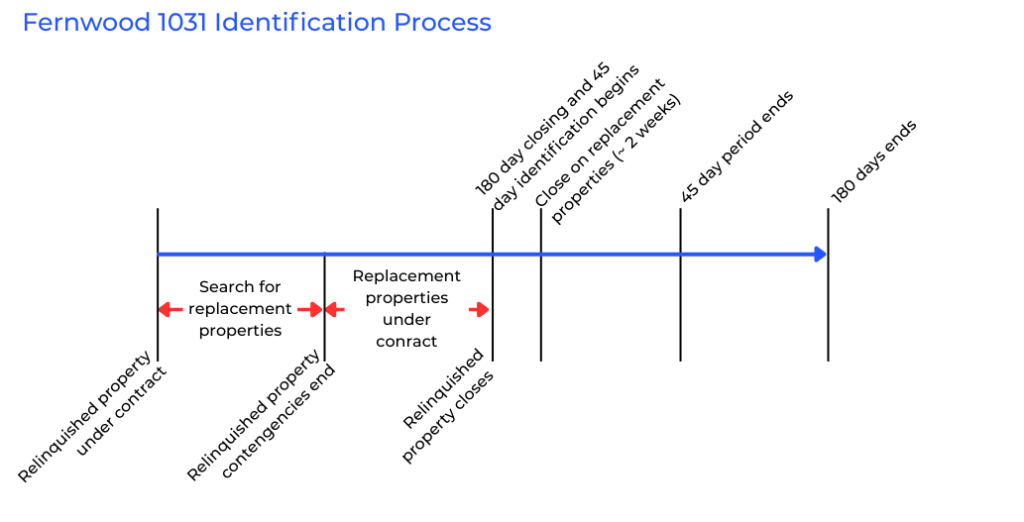
Step 1: Start Before Your Sale Closes
Do not wait for the closing date.
As soon as your relinquished property is listed for sale:
- Identify target market
- Select a local investment team to partner with
- Select a 1031 Exchange Agent (Qualified Intermediary (QI))
As soon as your relinquished property is under contract, begin:
- Searching for replacement properties
- Initial underwriting
This gives you time to evaluate options properly.
Step 2: Identify Replacement Properties Early
Technically, all you have to do during the 45-day window is identify up to three replacement properties. The issue arises when one or more of the identified properties do not close, resulting in failed exchanges. This is crucial when there are multiple replacement properties. You want multiple viable options before your 45-day window begins.
This allows you to:
- Have multiple backup options
- Eliminate weaker options
- Focus on long-term performance, not urgency
Step 3: Validate Tenant Demand and Rent Stability
No property pays rent. Tenants do.
Before selecting a property, confirm:
- Who the target tenant is
- Whether that tenant segment is reliable
- Whether similar properties are already renting successfully
This step protects your income after the exchange.
To learn more about our tenant-centric investment framework, check out this guide: Why Tenants Determine Rental Investment Performance.
Step 4: Secure Properties Before the 45-Day Deadline
Once your relinquished property clears contingencies:
- Put replacement properties under contract
- Position yourself to close early
This reduces uncertainty and removes last-minute decisions.
Step 5: Close Early in the Identification Window
The goal is not to use all 180 days to close.
The goal is to close within the 45-day identification window with strong properties. This minimizes the risk of not being able to close on any identified properties.
In many cases, replacement properties can be closed within the first two weeks of the identification period. If any of the properties under contract fail to close unexpectedly, you still have time to put backup replacement properties under contract and clear inspection before the 45-day identification window closes.
Where Most 1031 Exchanges Go Wrong
From experience, most problems follow the same pattern.
1. Starting the Search Too Late
This is the most common issue.
Investors wait until the sale closes. By then, the clock is already running.
2. Choosing Based on Availability Instead of Quality
When time is limited, the decision shifts.
Instead of asking:
- “Is this a strong long-term investment?”
The question becomes:
- “Will this meet the 1031 requirement?”
At that point:
- Standards drop
- Better options are no longer available
- The property is selected because it is available, not because it is the right fit
This is where most long-term performance problems begin.
3. Focusing on the Wrong Metrics
Many investors rely on simple rules:
- Price-to-rent ratios
- Cap rates without context
These do not measure long-term performance.
They ignore:
- Tenant segment the properties attract
- Rent growth
- Local demand
4. Skipping Proper Validation
Rushed decisions lead to:
- Incomplete inspections
- Weak underwriting
- Poor tenant alignment
These problems show up after closing.
5. Missing Some Finer Prints
Below are some details that, if not paid attention to, could fail your exchange:
- The funds from the sale of the relinquished property must go from the closing escrow company to the 1031 exchange agent. If the funds are in your direct possession at any point, you will likely lose the tax deferment.
- You are not allowed to use the proceeds from the relinquished property to pay for renovations. Some of our clients have opted to pay capital gains tax on a portion of the proceeds and use that money for the renovation.
- Not all sale & purchase contracts include 1031 exchange verbiage. Have your listing agent obtain the correct verbiage from your QI for your state and include it in the agent-to-agent remarks, specifying that the 1031 text must be included in the offer.
- If the relinquished property has a mortgage, it’s important to determine how it will be handled during the exchange. Any reduction in debt or cash received may be treated as taxable boot, resulting in potential tax liabilities. Talk to your 1031 exchange agent.
- Both the relinquished and replacement properties must meet the requirement of being held for investment or used in a trade or business. Personal residences or properties primarily held for personal use do not usually qualify for a 1031 exchange.
- It’s important to understand the state-specific regulations regarding like-kind exchanges. Some states may not recognize or fully conform to the federal provisions. Consult with a tax professional familiar with your state’s laws.
What a Strong Replacement Property Should Do
A replacement property should do more than complete the exchange.
It should:
- Produce reliable rental income
- Attract long-term tenants
- Support rent growth over time
If the property cannot do these three things, the exchange may defer taxes but reduce future income.
Our Experience With 1031 Exchanges
Over the past 17+ years:
- We have completed 90+ 1031 exchanges
- We have had zero failed exchanges
- In multiple cases, a single property was exchanged into six or more replacement properties
Our results are not due to luck.
It is process.
We start early, remove time pressure, and focus on long-term performance.
How to Evaluate Your 1031 Strategy
Before moving forward, ask:
- Have I started early enough to avoid pressure?
- Do I have multiple strong options?
- Am I choosing based on quality, not timing?
If the answer to any of these is no, the process needs to be adjusted.
If you are currently under contract, or considering a 1031 exchange, timing matters.
The replacement property search should begin before your sale closes, not after.
If you want to review your situation and timeline:
👉 Schedule a 30-minute 1031 Strategy Call